
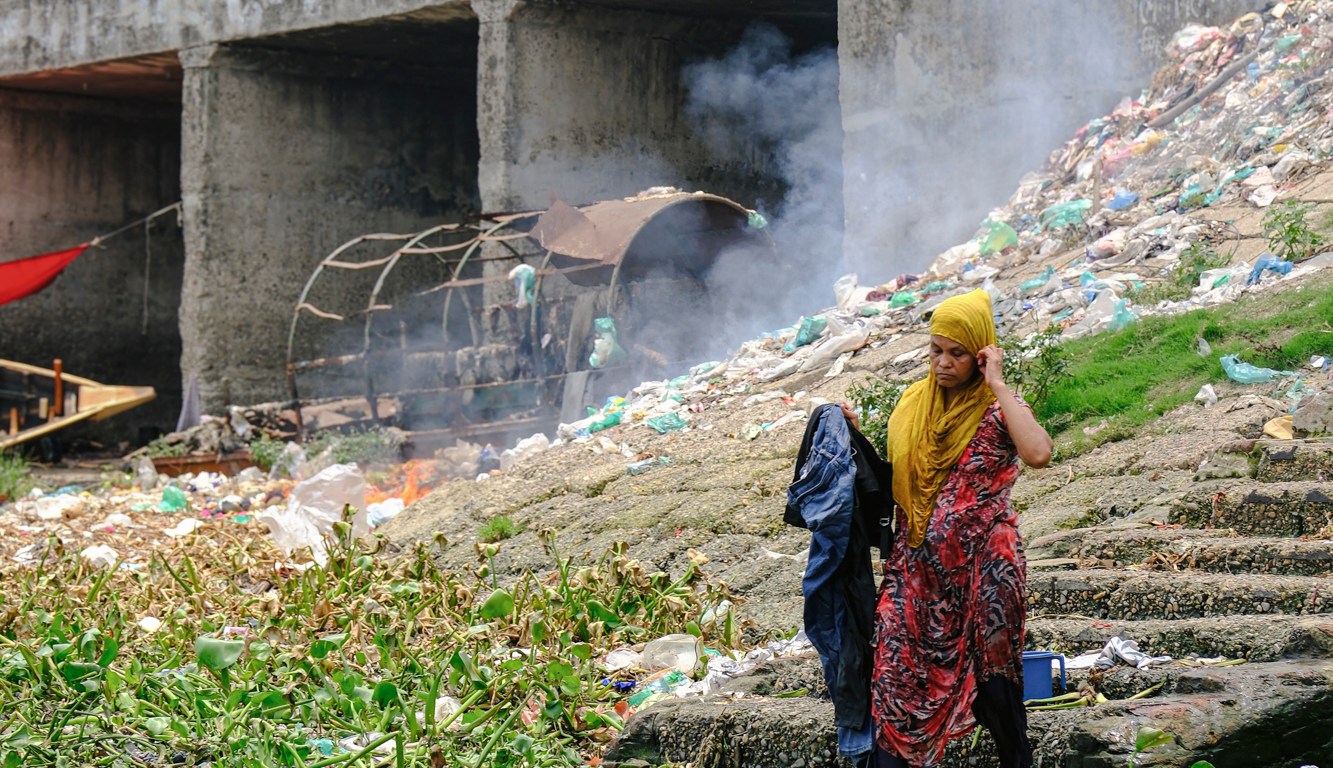
Single use plastic is everywhere in Bangladesh. Just like elsewhere in the world, people here are ordering food online and leaving the stores with goods wrapped in plastic wrap. More people here are drinking from plastic bottles – water and soda – because the tap water is not safe even for the residents to drink without boiling.
The plastic waste is everywhere. It has accumulated on the shore line, where it is then set ablaze. Plastics have found their way to the gutter on the side of the road, along with plastic floating along the river.
Shopping habits developed during COVID lockdowns have made the problem worse, said Farhan Intisar Ahmed, the head of marketing for a sustainable grocery delivery service in Dhaka.
“COVID taught a lot of people that you can get stuff while sitting at home, including my mother,” Farhan said. “Previously she always used to either go herself or send my father or send me to the shops to get stuff.”
According to a report, “Wrapped in Plastic: The State of Plastic Pollution in Bangladesh,” by the Centre for Policy Dialogue in Dhaka, per capita plastic consumption in Dhaka has more than doubled since 2005. Just less than half of that ends up in landfills. Just more than a third is recycled. And over 10% makes its way into Bangladesh’s rivers, which ultimately contribute to a global problem of plastics in the oceans.
For people who live or work outdoors plastic waste is ubiquitous. Subsistence farmers or fishing families, or the almost 20 percent of Bangladeshis living below the poverty line come into direct contact with it throughout their day. For some, waste plastics are also a resource and local people created unique ways to reuse the single-use plastic that tends to pile up around their homes.
Bazar365 in Dhaka is interested in reusing what plastics they cannot avoid in the grocery delivery process. A novel project has been to grind bottle caps and spin the plastic flecks into the filament that feeds 3-D printers. A 3-D printed action figure is a cute proof of concept for second-sourced bottle tops.
Customers can send their used plastic back to Bazar365 and they will use it to make something new.
“We ask them to provide us with the plastic waste they generate, then we try to create something meaningful out of it,” Farhan said. The goal is to “ensure that their event does not ensure more plastic pollution.”
Bazar365 also reuses chip bags to make an up and coming product that will be available on their website in the future.
For example, the company is hiring local people to clean and process chip bags, which are then woven together into a colorful, durable fabric that is made into sturdy laptop, grocery or travel kit bags
In and around fishing villages in the Sundarbans region, plastics were a resource to meet numerous needs:
· Plastic bottles were cut and stacked together to form a long arching pipe to move rainwater from their tin or thatch roofs into rain barrels, a makeshift gutter system.
· Lamp shades were crafted from fashioned from clear bottles to protect bulbs hanging outside in public places.
· Larger colored bottles made fishing buoys that supported nets, lines or hooks. They were easy to spot on the murky water or at rest on the gray, muddy shores at low tide.
· Windmills or weathervanes were made out of plastic bottles cut and bent so that strips of plastic flaps that catch the wind and spin furiously on a dowel.
Despite a wealth of plastic waste in Bangladesh, very little is recycled. In Khulna, city managers are exploring novel ways to create incentives for getting plastics off the street.
A German firm has created a “plastics ATM” that makes a cash payout for returned bottles that the city is looking to install to promote recycling habits citywide.
 UM to Bangladesh